
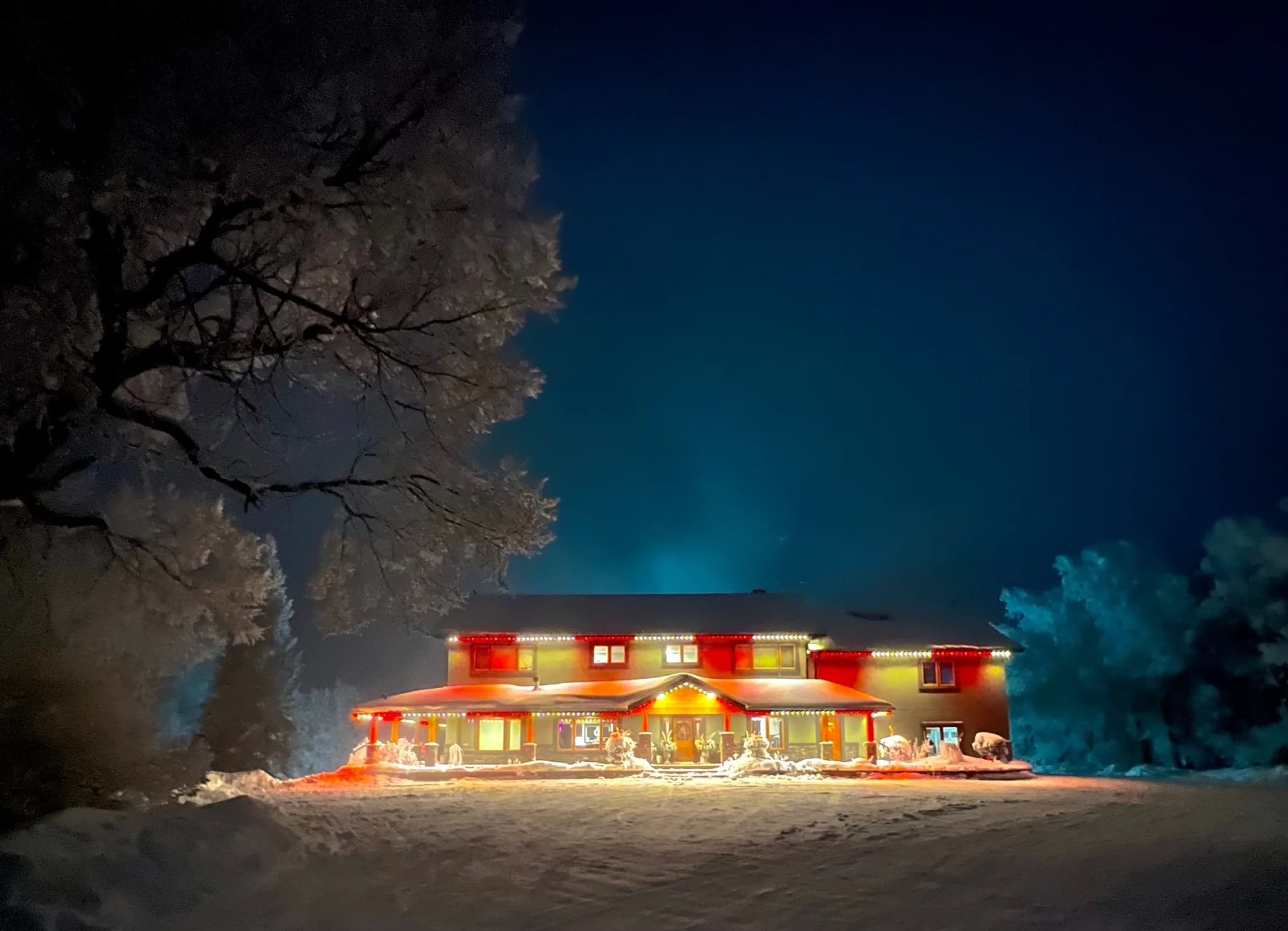
Guides/Buying guides·8 min read·Updated September 4, 2026
Colour temperature explained without the jargon, which white flatters brick, stone, vinyl and modern exteriors, when single colours and multicolour earn their place, and how to keep everything on the property reading as one display.
Key takeaways
- 1Warm white reads as golden and traditional, cool white reads as crisp and icy; neither is better, but one of them will suit your exterior noticeably more than the other.
- 2Red brick, stone and earth-toned siding almost always look best in warm white, while grey, white and charcoal modern exteriors can carry cool white well.
- 3Mixing warm and cool white on the same roofline looks like mismatched bulbs; if you want both, separate them by zone with a clear purpose for each.
- 4Multicolour and single-colour C9 work best when the colour on the roofline is repeated somewhere else on the property, such as a tree, wreath or garland.
- 5Decide the colour before you order, buy every run from the same product line so the whites match, and judge the result from the street at night rather than up close.
The C9 bulb is the workhorse of roofline lighting. It is the big faceted bulb you see outlining eaves and gables on the nicest houses on the street, and once you have chosen it, the first real decision is colour. Warm white, cool white, a single colour or the classic multicolour mix all use the same E17 base and the same socket wire, so the choice is entirely about how the house will look after dark. This guide walks through colour temperature in plain language, which white flatters which exterior, when colour makes sense, and how to keep a whole property looking like one deliberate display rather than a collection of strings bought over several years.
Colour temperature without the jargon
Warm white and cool white are both white, but they lean in different directions. Warm white has an amber tint, close to the glow of an old incandescent bulb or a candle. Cool white leans toward blue, closer to fresh snow under a bright moon. Lighting professionals describe this with a Kelvin number where lower values are warmer and higher values are cooler, but you do not need the number to make a good choice. What matters is how each tint looks against the colour of your house, and that is something you can only judge with a bulb in hand at night.
The incandescent C9 bulbs many of us grew up with were warm by nature, because a hot filament makes amber light. LED C9 bulbs can be built to either tint, which is why the choice exists at all. Our faceted LED C9 bulbs come in warm white and cool white alongside red, green, blue, orange, yellow, pink, purple and multicolour, all on the same E17 base, so you can change your mind next season without touching the wire.
Which white suits which exterior
Red brick and clay-toned brick: warm white, almost without exception. The golden tint picks up the reds and browns in the brick and makes the whole face of the house glow. Cool white against red brick tends to flatten the colour and can give the mortar a faintly green cast, which is not what anyone wants in a photo. Much of the older housing stock across Southwestern Ontario is red or brown brick, which is a large part of why warm white is the default recommendation for most homes in the region.
Stone, stucco and earth-toned siding: warm white again. Stone with cream, tan and grey mixed through it responds beautifully to an amber tint, and stucco in beige or sand tones does the same. If the stone is a cold grey with no warm veins in it, cool white can work, but warm white is still the safer choice because it flatters wood doors, cedar soffits and any landscaping lit in the same colour.
Vinyl siding: this depends entirely on the siding colour. Cream, beige, tan, sage and clay vinyl all lean warm, so warm white is the natural pairing. Grey, blue-grey, slate and white vinyl can go either way. Cool white looks clean and modern on those colours, especially with black or charcoal trim, while warm white softens them and reads as more traditional. If the trim is white and the siding is white, cool white can look almost clinical, so hold a sample of each against the fascia before deciding.
Modern homes with black trim, charcoal or white: cool white suits sharp lines, flat rooflines and dark cladding. It emphasises the geometry rather than softening it. The exception is a modern home with warm accents such as a cedar soffit, a stained wood front door or a natural stone feature wall. In that case warm white still works because it ties those elements together, and the house reads as intentional rather than stark.
Mixing warm white and cool white
On a single run, mixing the two tints looks like a mistake. The eye reads alternating warm and cool bulbs as bulbs that do not match, not as a design choice. If you want both on the property, separate them by zone and give each zone a reason to exist. A common and effective combination is warm white on the roofline and porch with cool white on a single spruce or a row of shrubs, so the tree looks frosted against the golden house. Keep each zone to one tint and the contrast becomes a feature.
Remember that the house already has lights you did not buy for Christmas. Porch fixtures, garage lanterns and path lights all have their own tint, and a warm porch lantern beside a cool white roofline will look yellow by comparison. Swap the fixture bulb to match the roofline for the season, or accept the porch as its own warm zone.
Pre-lit wreaths and garland arrive in whatever white the manufacturer chose, and it rarely matches another brand exactly. Hold the wreath next to your C9 sample with both lit before you hang either. A wreath slightly warmer than the roofline is fine on a front door, because a little extra warmth at the entry looks welcoming. A wreath cooler than a warm white roofline looks like a spotlight.
When multicolour or single colours work
Multicolour is the classic playful look and it still has a place. It works best on simpler rooflines where the colour itself is the decoration, and on homes with children who want the house to look like Christmas rather than a magazine cover. Because the faceted lens on a C9 throws light outward, multicolour reads strongly from the street even at one bulb per foot. It suits homes with a lot of architectural detail less well, because colour adds noise where the eye already has plenty to look at.
Single colours are more flexible than people expect. Red and green alternating along the roofline is the traditional pairing and it suits brick and stone. Blue and cool white together make a winter theme that looks especially good on grey and white homes. All red on a white house is bold and clean. Orange and purple carry a display through October, and because every colour shares the same E17 base you can swap October bulbs for December bulbs on the same socket wire in an afternoon. Pink and purple make a softer look that some homeowners use for a cause or simply because they like it.
- Red and green alternating on the roofline, with warm white on the porch so the entry stays inviting.
- Blue and cool white on the house, repeated in a blue-lit tree so the colour has a second home on the property.
- All warm white on the house with multicolour confined to one feature tree, which gives the colour a place without scattering it.
- Orange and purple in October, swapped to red and green or warm white in November on the same wire.
Matching landscape, trees and wreath lighting
The roofline sets the tone and everything else supports it. Trees and shrubs are usually lit with 5mm mini light strands rather than C9, and mini lights are a different product with their own version of warm and cool white. Whites can vary between manufacturers and even between product lines, so buy the mini strands at the same time as the C9 bulbs and compare them lit before the ladder comes out. Our 5mm strands use a 180-degree lens and are available with a twinkle effect, which adds movement to a tree without changing its colour.
A useful rule is to decide on one white for the whole property, then allow yourself one accent colour and one place for it. A warm white house with a single blue tree is cohesive. The same house with a blue tree, a red wreath, multicolour shrubs and a green garage door is four displays fighting for attention.
Keeping the whole display cohesive
- One white temperature per property unless you are deliberately zoning, and then no more than two zones.
- Repeat any accent colour at least twice, such as roofline and tree, or wreath and garland, so it reads as intentional.
- Match the socket wire to the surface it sits on: green wire on shingles and greenery, white wire along white fascia, soffit and trim. Our socket wire spools come in both.
- Keep bulb spacing consistent. Our socket wire uses 12 inch spacing, which gives a clean, even line; mixing in a string with tighter or wider spacing shows immediately from the street.
- Buy enough of the same bulb, from the same order, to finish the whole job with spares. A 500 pack covers most whole-house rooflines with bulbs left over for replacements, and it avoids the slight tint difference that can appear when you top up later.
How the display photographs at night
Phone cameras expose for the brightest thing in the frame, and lit bulbs against a dark house are very bright. Warm white photographs as a golden glow that most people find flattering. Cool white can come out looking blue or slightly purple in photos, more so than it does in person, especially on a snowy night when the camera is already struggling with white balance. For the best photo, shoot at dusk rather than full dark, in the short window when the sky is still deep blue, the house is still visible and the lights are already glowing. Turn off floodlights and motion lights first, and shoot from across the street so the roofline reads as a shape rather than a row of dots.
A note for installers
Colour is the first question to ask a client and the one that generates the most call-backs when it is guessed. Carry a short tail of socket wire with a vampire plug on one end and a few bulbs of each white so you can light both against the client's house during the estimate. It takes two minutes and settles the question before any product is cut. Stock warm white in depth, keep cool white and a few colours on hand for the modern builds and the families who want a bit of fun, and order 500 packs through the pro-installer program so every run on a property comes from the same batch. If you are still unsure after all of this, choose warm white: it flatters more surfaces, photographs more easily, and is what most people picture when they think of a lit house.
Frequently asked questions
Is warm white or cool white the better choice for most homes?
Warm white suits the widest range of exteriors, particularly brick, stone and earth-toned siding, and it photographs more easily. Cool white is the better fit for grey, white or charcoal modern homes with dark trim. If you are unsure, warm white is the safer default.
Can I mix warm white and cool white bulbs on the same string?
Physically yes, because both use the same E17 base and fit the same socket wire. Visually it looks like mismatched bulbs rather than a design choice. If you want both tints on the property, separate them into zones such as a warm white roofline and a cool white tree.
Which C9 colour works best on a red brick house?
Warm white. The amber tint brings out the reds and browns in the brick, while cool white tends to flatten the colour and can give the mortar a greenish cast. Red and green alternating is a good choice if you want colour on brick.
Do coloured LED C9 bulbs look different from the old incandescent ones?
Yes. Incandescent colour came from a painted or tinted glass over a warm filament, so the colours were softer. LED colour comes from the diode itself, so red, green and blue are more saturated, and the faceted lens spreads that colour outward so it reads clearly from the street.
How do I make sure my tree lights match my roofline lights?
Buy the 5mm mini light strands and the C9 bulbs at the same time and compare them lit before installing. Whites vary between products, so choose one white for the whole property and, if you want colour, repeat the same accent colour in one or two places rather than adding new ones.
Stock up
Everything in this guide ships from London, Ontario.
Installer-grade C9 bulbs, socket wire, SPT-2 spools, plugs, clips and 12V permanent lighting kits. Free Canadian shipping over $500.
Keep reading
Buying guides · 8 min
SPT-1 vs SPT-2 Wire: Which Do You Need for Christmas Light Runs?
What the SPT-1 and SPT-2 designations actually mean, why the difference is in the jacket rather than the copper, why professional crews standardise on SPT-2 for C9 runs, and how to choose spool length and colour for your roofline.
Buying guides · 8 min
C9 LED vs Incandescent Bulbs: Which Is Right for Your Roofline?
An honest comparison of faceted C9 LED bulbs and the old incandescent C9s: how they look from the street, how much power they draw, how many fit on a circuit, how they behave at minus twenty, and how to retrofit an existing socket line.
Buying guides · 9 min
Christmas Light Clips Guide: Shingle, Parapet, Universal, Adhesive and Stakes
The right clip for every surface on a Canadian home or commercial building, how far apart to place them, how many to order per 100 ft of C9 line, how to take them down at season end, and the shortcuts that damage roofing.