
Guides/Planning·10 min read·Updated September 4, 2026
How the seasonal model actually works, the handful of products a new installer really needs, building custom-length runs, pricing by the foot, ladders and insurance, storage in the off-season, and adding permanent LED kits so the business runs all year.
Key takeaways
- 1The season is short and front-loaded: sell in September and October, install in November, service through December, take down in January, then store and rebook.
- 2A new installer needs surprisingly little stock: C9 LED bulbs in 500 packs, socket wire spools, SPT-2 plain wire, vampire plugs, replacement sockets and a clip assortment.
- 3Custom-length runs built from socket wire and cut to the roofline are what separate a professional install from a homeowner one, and they are quicker to hang than boxed strings.
- 4Price by the linear foot with tiers for height and pitch, include takedown and storage in the fee, and let the product pay for itself across several seasons.
- 5Permanent 12 volt LED roofline kits turn a three-month business into a year-round one, and a pro-installer program with tier pricing and net-30 keeps margins predictable.
Christmas light installation is one of the few trades where a person with a ladder, a truck and a few thousand feet of wire can book a full season of work from a single neighbourhood. It pairs naturally with landscaping, window cleaning, eavestrough work and deck staining, all of which slow down exactly when lighting picks up. This guide is for anyone in Ontario or elsewhere in Canada thinking seriously about doing it, and for contractors adding it as a winter line. It covers the business model, stock, custom runs, pricing, ladders and insurance, storage, and how permanent LED kits extend the season to twelve months.
The seasonal model
The calendar is compressed and front-loaded. Selling happens in September and October, while you can still walk a property without gloves. Installs run from late October into early December, with the heaviest weeks right after Remembrance Day. December is mostly service calls: a dark section after a wind storm, a tree that needs re-wrapping, a client who wants one more thing. Takedowns happen in January on days above freezing, and February through August is storage, reorders and booking next season before anyone else does.
There are two ways to structure the work. In the lease model the installer owns the lights and the client pays a seasonal fee covering install, service, takedown and storage; the product comes back every January and goes out again the next fall. In the sale model the client buys the lights and pays for labour. Lease builds recurring revenue and keeps the client tied to you, because their display lives in your storage. Sale needs less capital and suits one-off jobs. Many established installers lease residential and sell or offer both on commercial.
What to stock in year one
New installers tend to over-buy variety and under-buy depth. The professional approach uses a small number of products in quantity, all compatible with each other, so every job on the truck draws from the same bin.
- C9 faceted LED bulbs with the E17 base, in 500 packs. Warm white is the volume colour; keep cool white, red, green and multicolour on hand for the clients who want them.
- C7/C9 empty socket wire spools with 12 inch socket spacing, in 1000 ft spools, in both green and white so the wire disappears against shingles or against white fascia.
- SPT-2 18 AWG plain wire in 500 ft spools, white, green and black, for leads from the outlet to the first socket and for jumps across gaps where you do not want a lit bulb.
- Male and female SPT-2 vampire plugs in bulk. Every run needs a male plug, and a female plug or a cap on the far end.
- Replacement E17 sockets, so a damaged socket becomes a five-minute fix on the tailgate rather than a scrapped run.
- A clip assortment: shingle-tab clips for the roof edge, parapet clips for flat commercial rooflines, universal and duckbill clips for fascia and gutters, adhesive mini-light clips for windows and trim, and light stakes for walkways.
- 5mm mini light strands with a 180-degree lens for trees and shrubs, including a twinkle option, which is the second most requested item after the roofline.
That list covers most residential work. Add wreaths and garland once you know which white your client base prefers, because a wreath that does not match the roofline is a call-back, and batch restocks into a couple of larger orders per year to take advantage of free Canadian shipping over the order threshold.
Building custom-length runs
Boxed strings come in fixed lengths that never match a roofline. Professionals measure the fascia, cut socket wire to the exact length, and build the run on the ground before it goes up. Measure each straight section and gable on the estimate and sketch it, because the sketch becomes both the cut list and the labelling map. On install day, cut the socket wire, snap a male vampire plug on the end nearest the outlet, add a female plug or a cap on the far end, and bulb the run on the tarp. Where the outlet is some distance from where the lit section starts, use a length of plain SPT-2 wire as a lead so no empty sockets hang at eye level. Plug it in and check every bulb before the first foot goes on the ladder.
Build one run per straight section or per plug rather than one enormous run for the whole house. Shorter runs are easier to hang, store and swap when a section fails. Keep the load of each run and everything chained to it under the rating printed on the wire and plug, and check the circuit rating on the client's outlet rather than guessing.
Pricing per foot, in general terms
Residential roofline work is usually quoted per linear foot installed, with tiers for height and pitch, because a single-storey ranch and a steep two-storey with dormers take very different amounts of time per foot. Trees are quoted per tree by size, wreaths and garland per piece, and ground stakes per run. In the lease model the fee covers install, one or two service calls, takedown and storage, and the product cost is recovered over several seasons rather than in the first year. In the sale model the product is a line item and labour is separate.
Whatever the numbers are in your market, the fee has to cover the product amortised over its working life, labour for two trips, drive time, replacement bulbs and clips, insurance, and a margin. Set a minimum job value so a single porch does not consume a morning. Take a deposit at booking, because a client who paid in October does not cancel in November. Raise prices modestly each year, and be prepared to say no to properties that will never be profitable.
Ladders, lifts and insurance
This is a job done at height, on cold days, often on a roof edge with frost on it. Take that seriously from the first job. A good extension ladder with a standoff so it rests on the roof rather than the gutter is the basic tool, and a roof anchor and harness is the professional standard above a single storey. For tall commercial buildings and large trees, renting a lift is safer and faster than any ladder and fits comfortably inside a commercial quote. Once you hire anyone, Ontario has working-at-heights training and fall protection requirements for employees, so build that in before the first hire.
On insurance, carry general liability from day one, because you will be on other people's roofs and near their windows. Confirm your vehicle policy covers commercial use with a ladder rack, and once there are employees, register with the provincial workplace insurance program, which in Ontario is the WSIB. Commercial clients and property managers will ask for a certificate of insurance before you set foot on site.
Storage and the off-season
In the lease model, storage is the business. Every client's runs come back in January and need to go out again in November in working order. Coil each run loosely on a reel or in a large loop, never tight around a board, and bin them by client with the sketch taped inside the lid. Store in a dry space that does not swing to attic temperatures in July. A garage bay, a rented locker or a corner of a shop all work if they stay dry. Test everything in August, replace tired bulbs and sockets, and reorder in summer while stock is easy to get and the shipping is not competing with everyone else's November.
The off-season is also when the next season gets sold. Send rebooking notices in late summer, ask for referrals while the neighbours still remember the display, and photograph every install at dusk in December so you have real images for the fall. Yard signs on lit properties, a Google Business Profile with those photos and a simple booking form will bring in more work than paid advertising in the first two years.
Adding permanent LED kits as a year-round offer
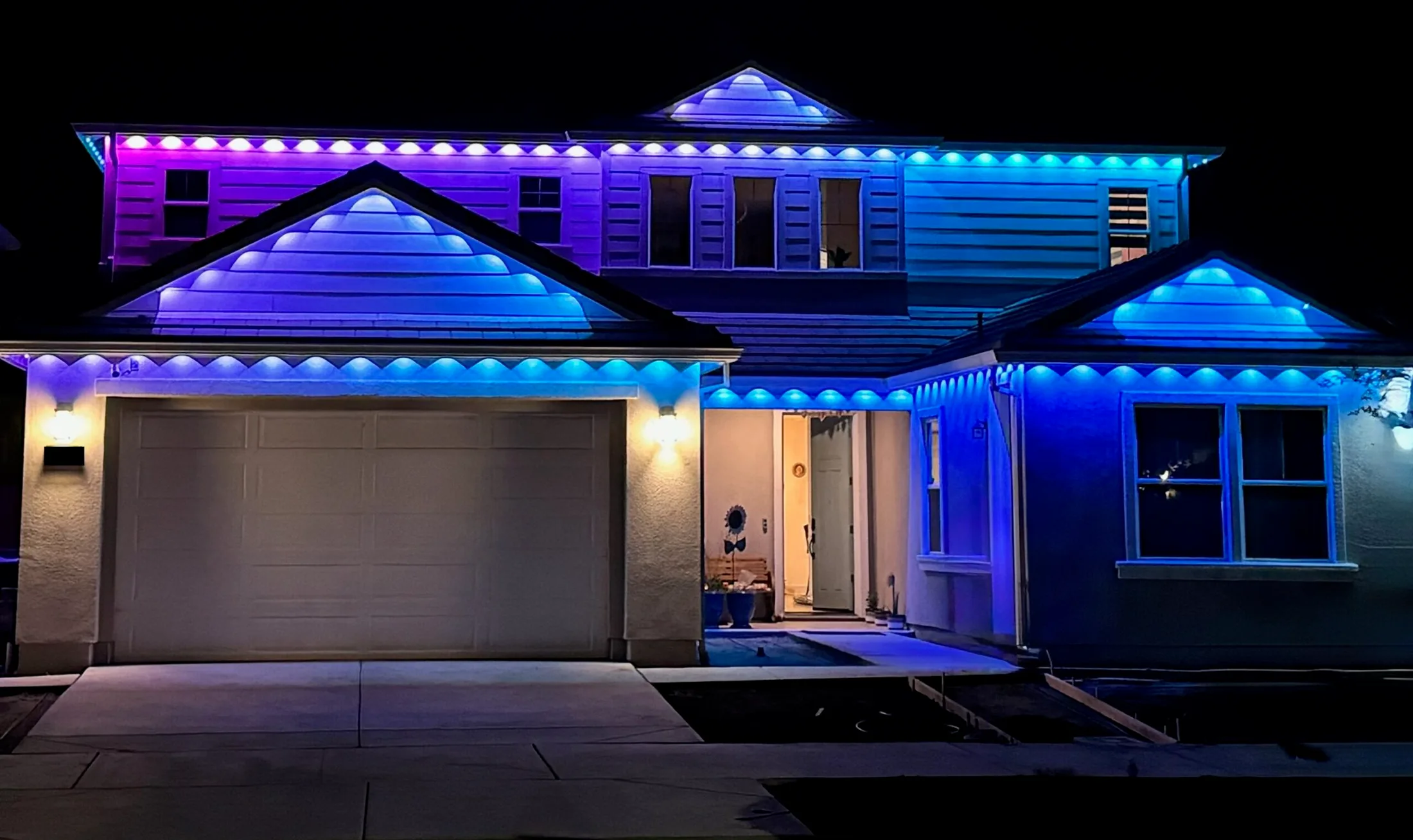
The obvious weakness of a lighting business is that it earns for three months. Permanent LED roofline lighting fixes that. The kits use a low-profile aluminum track in 42 inch sections with RGBW pucks, a 12 volt supply, sealed connectors and a WiFi controller with an app, and they are installed once under the soffit or along the fascia. Kits are sized from 50 ft to 250 ft and the track comes in black, white, wicker and brown to match common soffit and fascia colours. The install is a spring, summer or fall job, which is exactly when a seasonal crew has nothing to do.
For the client, the appeal is that the lights are always there: warm white on ordinary evenings, red and green in December, orange in October, team colours for a playoff run, all from a phone. For the installer, it is a higher-ticket job with no takedown, no storage and a 5-year warranty on the product standing behind the quote. Many installers introduce it during a seasonal estimate as the option that never needs a ladder again, and a meaningful share of seasonal clients convert over a few years. It also opens commercial work, since a business that lights its building for the holidays will often pay to light it all year.
Using a pro-installer program
Buying at retail one box at a time does not work once you are lighting dozens of homes. Our pro-installer program is built for exactly this stage: tier pricing that improves as your volume grows, net-30 terms so product for November installs can be paid from November invoices, and the same product line year after year so a run built this season matches one built three seasons ago. Everything ships from London, Ontario, which keeps delivery times short for installers anywhere in the province and reasonable across the rest of Canada.
There is also a municipality and BIA program for installers who take on downtown streetscapes, business improvement areas and public spaces. Those jobs need long socket wire runs, parapet clips, a lot of bulbs in one colour and a supplier who can deliver on a purchase order. If you are already comfortable on a lift, a single BIA contract can anchor a season. Start with one neighbourhood you can drive in ten minutes, light enough homes there that the street sells itself, and let the rest grow from that.
Frequently asked questions
How much stock do I need to start a Christmas light installation business?
Less than most people expect. A 1000 ft spool of socket wire in green and one in white, a few 500 packs of warm white C9 LED bulbs, a spool of SPT-2 plain wire, a bag each of male and female vampire plugs, replacement sockets and a mixed box of clips will cover a first handful of residential jobs. Buy depth in the products you use on every house before adding variety.
Should I lease lights to clients or sell them?
Leasing means you own the product and the client pays a seasonal fee covering install, service, takedown and storage, which builds recurring revenue. Selling needs less capital and suits one-off or commercial jobs. Many installers lease residential and sell or offer both on commercial work.
How is Christmas light installation usually priced?
Roofline work is generally quoted per linear foot installed, with higher rates for second storeys and steep pitches. Trees are priced by size, wreaths and garland per piece. Takedown and storage are typically included in a lease fee, and a deposit is taken at booking.
What insurance does a Christmas light installer need in Ontario?
General liability from the first job, a vehicle policy that covers commercial use, and WSIB registration once you have employees. Employees working at height also fall under Ontario working-at-heights training and fall protection requirements. Commercial clients will ask for a certificate of insurance.
How do permanent LED kits fit into a seasonal lighting business?
They fill the empty months. The 12 volt track kits install in spring, summer or fall, carry a 5-year warranty, need no takedown or storage, and give seasonal clients an option that never needs a ladder again. Installers often introduce them during a seasonal estimate and convert clients over a few years.
Stock up
Everything in this guide ships from London, Ontario.
Installer-grade C9 bulbs, socket wire, SPT-2 spools, plugs, clips and 12V permanent lighting kits. Free Canadian shipping over $500.
Keep reading
Planning · 9 min
How to Measure Your Roofline for Christmas Lights and Permanent LED Track
The tools, the technique for eaves, gables, peaks and returns, the allowances for corners and offcuts, and how to turn a total in feet into C9 bulbs at 12 inch spacing or a permanent kit size, with a worked example for a two-storey Ontario home.
Planning · 9 min
How Many Christmas Lights Can You Run on One Circuit? Watts, Amps and Safe Runs Explained
The plain arithmetic behind a tripped breaker: what watts and amps actually mean, why LED C9 bulbs changed the limits, how to read the rating on wire and plugs, and how to split a display so nothing runs hot.
Buying guides · 8 min
SPT-1 vs SPT-2 Wire: Which Do You Need for Christmas Light Runs?
What the SPT-1 and SPT-2 designations actually mean, why the difference is in the jacket rather than the copper, why professional crews standardise on SPT-2 for C9 runs, and how to choose spool length and colour for your roofline.