
Guides/Permanent lighting·9 min read·Updated September 4, 2026
A straight comparison of a permanent 12 V track kit and a seasonal C9 display on clips: what each costs in general terms, the labour every year, how they look in daylight, colour flexibility, how they hold up in Ontario winters, and when each is the right call.
Key takeaways
- 1Seasonal C9 runs on clips cost less to get started and let you buy exactly the colour you want, while a permanent kit costs more up front and then asks almost nothing of you for years.
- 2The yearly labour is the real dividing line: seasonal lights go up and come down every year, on a ladder, in cold weather; permanent track is installed once.
- 3In daylight, a permanent track in a colour matched to the fascia is close to invisible, while a C9 display shows its wire and bulbs until it comes down.
- 4Permanent RGBW pucks change colour from an app for any occasion; a C9 display changes colour only when you swap the bulbs, but the faceted bulb has a sparkle the puck does not imitate.
- 5Many homes end up with both: a permanent roofline for year-round use and seasonal C9 or mini lights on trees, wreaths, railings and shrubs that no track can reach.
We sell both, so we have no reason to push you one way. Installers order our C9 bulbs and socket wire by the case for seasonal work, and homeowners and installers alike order the 12 V permanent kits for rooflines they never want to climb again. Each has a place. This guide lays out the honest trade-offs between a permanent track kit and a seasonal C9 display on clips so you can decide what fits your house, your budget and your tolerance for ladders in December.
What each option actually is
A seasonal C9 display is faceted LED bulbs screwed into socket wire at 12 inch spacing, held to the roof edge with clips: shingle-tab clips under the shingles, universal or duckbill clips on gutters and fascia, parapet clips on flat edges. It plugs into an outdoor outlet through a vampire plug, goes up in November and comes down in January. The bulbs come in warm white, cool white, red, green, blue, orange, yellow, pink, purple and multicolour, and the wire in green or white.
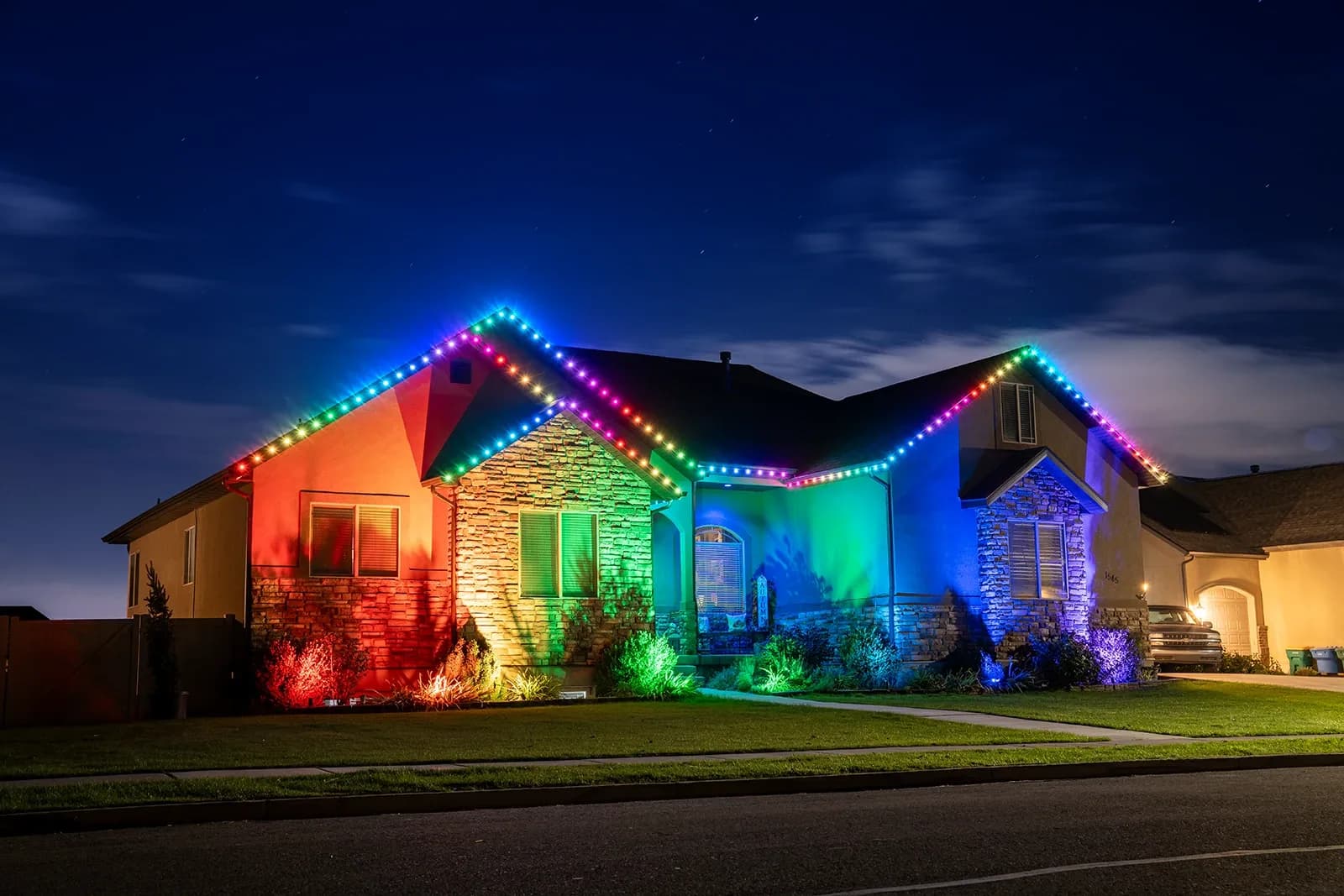
A permanent kit is a 12 V system: aluminum track in 42 inch pieces, each carrying five RGBW pucks, screwed to the fascia or soffit in a colour that matches it, black, white, wicker or brown. A 150 W power supply and a WiFi controller plug into an outdoor GFCI outlet, and an app on your phone picks the colour, brightness, pattern and schedule. It stays up year round and carries a 5-year warranty.
Upfront cost
There is no way around it: a permanent kit costs more to buy than a season's worth of C9 bulbs, wire, plugs and clips for the same roofline. You are paying for aluminum track, the electronics, the controller and the sealed connectors, and for a product engineered to stay outside for years. A seasonal setup for a typical two-storey front is a modest purchase by comparison, especially if you already own the clips and only need bulbs and wire.
The comparison changes if you pay someone to hang seasonal lights. A professional install and takedown each year is a recurring cost, and over several seasons it adds up to a figure in the same neighbourhood as a permanent install. If you do your own seasonal lights, the cash gap stays wide and the trade-off is your time and your ladder. If you hire it out, the permanent kit starts to look like a way to pay once instead of every year.
Labour, every single year
This is the dividing line for most people. Seasonal lights go up on a ladder in November, when the weather in Ontario is already unfriendly, and come down in January when it is worse. A two-storey front with gables is an afternoon each way with a helper, plus untangling, testing, replacing the few bulbs that did not survive the bin, and finding the clip that fell in the garden. Do it for a decade and you have spent a couple of full working weeks on a ladder in the cold.
A permanent kit is installed once. After that the yearly effort is opening the app. Nothing comes down, nothing is stored, nothing is untangled. For homeowners who are getting older, who have a steep or high roofline, or who simply do not want the ladder, this alone settles the question. For installers, it changes the business: a permanent install is one visit and a warranty instead of two visits a year for as long as the client stays.
How they look in daylight
Seasonal lights are meant to be seen at night, and in daylight they look like what they are: a wire with bulbs on it clipped to the roof. In green or white wire matched to the trim it is tidy enough for the six weeks it is up, and nobody minds Christmas lights on a house in December. Left up into March, they start to look like neglect.
A permanent track is designed for the other fifty weeks. Mounted tight under the drip edge in a colour that matches the fascia, it reads as a slim line of trim from the street, and most visitors do not notice it until the lights come on. Black on dark fascia and white on white are nearly invisible; wicker and brown cover the tan and earth-tone fascias common on newer builds. If you are particular about the look of your house in daylight, a permanent kit is the only one of the two that was designed with that in mind.
Colour and flexibility
A permanent kit wins on flexibility without contest. Each puck has red, green, blue and white diodes, so the same track does warm white on an ordinary Tuesday, red and green in December, orange and purple in October, and a team colour for the playoffs, all from the app. Scenes can be static, chasing or fading, scheduled to sunset, and changed from the driveway or from a cottage two hours away.
A C9 display does one colour scheme per season, and changing it means unscrewing bulbs. What it offers instead is the look itself. A faceted C9 bulb throws light in a sparkling pattern that a flat puck does not reproduce, and for many people that sparkle is Christmas. Warm white C9s on a roofline have a traditional depth that permanent pucks, which read as clean points of colour, approach but do not copy. If you love the classic look and only ever want it in December, the C9 display gives you exactly that for less money.
Durability in an Ontario winter
Both products are built for cold. Quality LED C9 bulbs and SPT-2 wire handle freezing weather, and the usual seasonal failures are mechanical rather than electrical: a clip that lets go in an ice storm, a run that a shovel catches, a bulb that cracks in the storage bin. Each season starts with a test and a few replacements, which is normal and cheap, but it is a task.
A permanent kit lives outside through everything: snow load on the eave, ice dams, freeze-thaw cycles, summer sun. The aluminum track, sealed pucks and twist connectors are made for that, and the 5-year warranty reflects it. The practical risks are installation quality rather than weather: a twist connector that was not fully seated, or a screw into fascia with nothing behind it. Done properly, a permanent kit needs less attention over five winters than a seasonal display needs in one.
Resale and the next owner
Seasonal lights go with you when you move, or into the garage sale. A permanent kit stays with the house and is a feature the next owner inherits, along with the app and the warranty. Whether it adds to the sale price is a question for your realtor and your market, but it is the kind of thing that photographs well in a listing at dusk and that buyers of newer homes increasingly expect to see. It also removes a chore the next owner would otherwise face, which is a quiet selling point on a two-storey with a steep roof.
When seasonal C9 lights make sense
- You love the classic faceted C9 look and only want lights in December.
- Your budget this year is for bulbs and wire, not a full system, and you are comfortable on a ladder.
- You rent, or you plan to move within a few years and want to take the lights with you.
- Your roofline is single storey and easy to reach, so the yearly hanging is a short job.
- You want to light trees, shrubs, railings, wreaths and columns, which permanent track cannot do.
When a permanent kit makes sense
- You have a two-storey or steep roofline and are done with ladders, or you have been paying an installer every year.
- You want lights for more than Christmas: Halloween, Canada Day, birthdays, or a soft warm white every evening.
- You care how the house looks in daylight and want the hardware to disappear.
- You plan to stay in the house long enough for the one-time cost to replace years of seasonal work.
- You are an installer building a book of clients who want a warranty and an app rather than a fall and spring visit.
Combining both: the setup most homes end up with
The two are not rivals on most properties. The permanent kit handles the roofline, the part that is high, awkward and worth doing once. Seasonal lights handle everything the track cannot reach: the maple in the front yard wrapped in 5mm mini-light strands, the porch railing and columns in C9s on clips or wire, the wreath on the door, the shrubs along the walk with light stakes, and the garland over the garage. In December the roofline goes red and green from the app, the trees glow warm white, and the whole front reads as one display. In January the trees and wreath come down in an hour, at ground level, and the roofline switches back to warm white.
For installers, this combination is the standard offer: sell the permanent roofline once, then return each fall for the ground-level seasonal work that is quick, safe and profitable. For homeowners, it means the ladder retires but the tradition does not. If you are weighing the two, the question is rarely which one, but which parts of the house get which. Measure your roofline, price a kit in the size you need, price the C9s and clips for the rest, and the answer usually becomes obvious.
Frequently asked questions
Is a permanent lighting kit cheaper than seasonal lights in the long run?
It costs more up front and less every year after. If you hang your own seasonal lights the cash gap stays large and you are trading money for your time on a ladder. If you pay an installer each year, several seasons of install and takedown add up to a figure in the same range as a permanent kit, which is then paid off.
Do permanent lights look like Christmas lights in the daytime?
No. The aluminum track mounts tight under the roof edge in black, white, wicker or brown to match the fascia and reads as a slim line of trim. Seasonal C9s on clips are visible as wire and bulbs until they come down.
Can permanent lights look like traditional C9 bulbs?
They can match the colours, including a warm white, and they can run static or chasing patterns. What they do not reproduce is the sparkle of a faceted C9 bulb. If that traditional look matters most to you and you only want lights in December, a C9 display gives it to you directly.
Which one holds up better in an Ontario winter?
Both are built for cold. Seasonal displays fail mechanically, with clips and bulbs needing replacement each year. A permanent kit's track, sealed pucks and twist connectors are designed to stay up year round through snow, ice and freeze-thaw, and carry a 5-year warranty. Install quality matters more than weather.
Can I use both on the same house?
Yes, and many homes do. The permanent kit covers the roofline, and seasonal C9s, mini-light strands, light stakes and wreaths cover trees, shrubs, railings, columns and doors that track cannot reach. The roofline changes colour from the app while the ground-level pieces go up and down at ground level.
Stock up
Everything in this guide ships from London, Ontario.
Installer-grade C9 bulbs, socket wire, SPT-2 spools, plugs, clips and 12V permanent lighting kits. Free Canadian shipping over $500.
Keep reading
Permanent lighting · 10 min
How to Install a Permanent LED Lighting Kit Yourself: A Step-by-Step Guide for Canadian Homes
Everything a handy homeowner or first-time installer needs to put up a 12 V permanent roofline kit: planning the run, mounting the aluminum track, connecting the pieces, placing the power supply and controller, and dialing in the first night.
Permanent lighting · 9 min
Power Injection and Data Amplifiers Explained: Why Long Permanent LED Runs Dim, and How to Fix It
A plain-language explanation of voltage drop and data signal loss on long permanent LED runs, the symptoms of each, what the power-injection T, 20 ft power extension and data amplifier actually do, and how kit contents scale with roofline length.
Planning · 9 min
How to Measure Your Roofline for Christmas Lights and Permanent LED Track
The tools, the technique for eaves, gables, peaks and returns, the allowances for corners and offcuts, and how to turn a total in feet into C9 bulbs at 12 inch spacing or a permanent kit size, with a worked example for a two-storey Ontario home.